Showing posts with label democratic reversals. Show all posts

Friday, 13 April 2012

West Africa’s looming anarchy


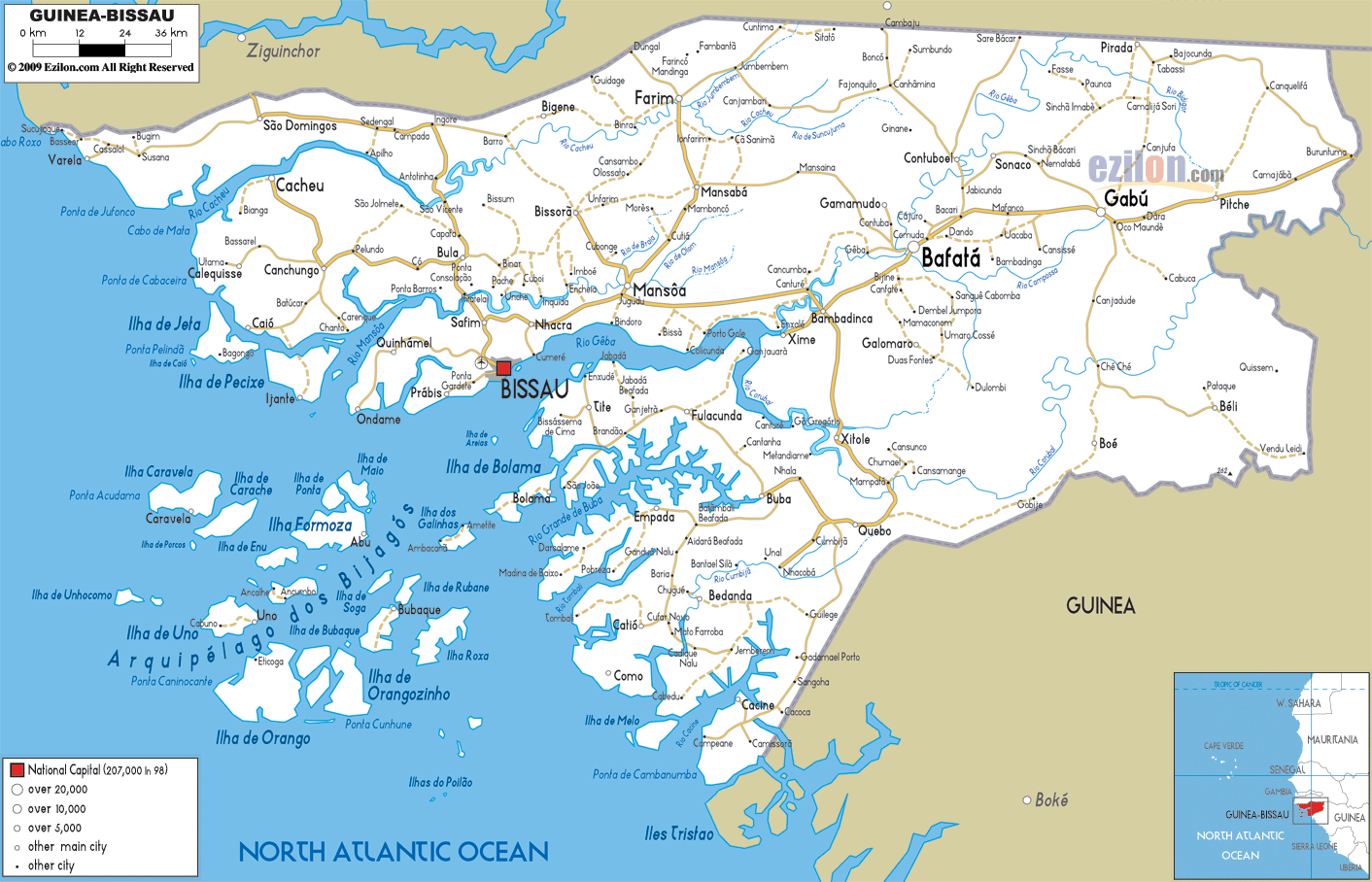
It was first Senegal, then it moved on to Mali and now it’s Guinea Bissau. Guinea Bissau is back in the news again with a thump and as it’s so associated with this small coastal West African nation with many islets in the Atlantic Ocean, it is for all the bad reasons.

West Africa is indeed an interesting sub-region of Africa. On Thursday, April 12, ECOWAS effectively forced Malian soldiers who annexed power in March 22 this year to hand over power to a civilian interim administration led by the former speaker of parliament, Dioncounda Traore.

Even as this was going on in the Malian capital Bamako, Guinea Bissau’s army were quietly fine tuning plans to topple the government and disrupt the April 29 presidential election run-off.

Guinea Bissau
The former Prime Minister, Carlos Gomes Júnior, who won the first round of the presidential election was almost certain of winning the run-off election. 

He is now under arrest, even feared dead, after the army attacked his house on Thursday night, three weeks after Mali’s former president was driven out of office by Capt Amadou Sanogo and his visionless, clueless and directionless thugs.

Disparagingly described by many as Africa’s first narco-state, the country is barely livable: high levels of unemployment, there are no factories, unexploited natural resources, dismembered police and ragtag army infested with narco-traders and associated violence.

Guinea Bissau is not Somalia for sure but it’s still a tough country by any standard. Both countries are ungovernable, even anarchic if you like. Robert Kaplan may not need to revise his 1994 thesis again anytime soon.

It’s scandalous to say that a country is used to coups but Guinea Bissau may be very close to this. Just as this morning, April 13, 2012, on December 26, 2011 the country’s population woke up to the sound of gun and artillery fire from an attempted coup d’tat while the President, Malam Bacai Sanha was receiving medical attention in France. 

The coup failed but the president also never recovered from his illness, diabetes.

Earlier in June 2009, just a couple of weeks to scheduled presidential elections (June 28 to be specific), the military assassinated Baciro Dabo, a leading presidential candidate and Helder Proenca, an ex-defence minister.

These killings took place on the same day but separately. Needless to say, both assassinations were linked. Dabo and Proenca were allegedly plotting a coup to kill Prime Minister Carlos Gomes Júnior and the country’s army chief of staff, Jose Zamora Induta. The same Gomes Júnior who was arrested during last night’s coup.

Gomes Júnior had resigned in February 2012, a month after former president, Sanha died in France, to contest the March presidential election. He won the first round by twice as many votes as his closest rival and former president, Kumba Yala. But with last night’s army putsch, the presidential run-off between will almost certainly not take place on April 29.

Violent clashes are not limited to the politicians and the soldiers in Guinea Bissau. Infighting within the army is intense and so is fighting within the dismembered police service and other Bissau’s security agencies. Factions regularly fight over which group controls the drugs trade and other resources of the country.

Gomes Junior casting his ballot
Irony: Guinea Bissau soldiers queue to vote
It’s a circle of mutinies, coups, uprisings, assassinations and now narcotics trade. Over the last few years, the viciousness seems to have been cranked up. 

It is easily attributable to the spoils of the drugs trade and the acute power struggle between the political class and the politically powerful military.

Guinea Bissau is now a major a staging post for the trans-shipment of narcotics from South America to coke-addicted Europe via West Africa. 

President Joao Bernardo ‘Nino’ Viera, who himself first came to power by toppling Luis Cabral, was murdered by the army on March 2, 2009. Viera’s assassination was partly fueled by an earlier bomb attack on and subsequent murder of his key political rival and army chief of staff, General Batiste Tagme na Waie long suspected to be involved in the drugs trade.

If you thought the plot of Guinea Bissau’s intriguingly opaque and checkered power struggle and political chess game is complicated, you're right. Dabo who was killed in June 2009, three months after the assassination of President Viera was a close associate of the president. 

The army apparently panicked Dabo could pursue them if he won the elections to jail those (soldiers and non soldiers) who plotted and assassinated Viera.

Economically, Guinea Bissau is an even more insignificant economy than Mali in West Africa but the danger it poses to the larger region is grave given its uncharitable reputable as a major narcotics transiting and arms trafficking enclave within the sub-region.

So what can we expect from the regional body, ECOWAS? ECOWAS will quickly get involved in Guinea Bissau as it has done before to restore order.

But the sub-regional grouping is likely to be more nuanced in how it tackles this country in comparison with Mali for a number of reasons not least because Bissau is a longstanding troubled country needing a more careful nudge to remold the failing state and move it and the long-suffering population away from a rather violent and unstable past to a stable and progressive path. 

Put simply, ECOWAS won't adopt a 'machoman' posture with Bissau.

Over to you, ECOWAS!

Tuesday, 3 April 2012

Captain Sanogo’s Catch-22

The military thugs in Mali seem to have beaten far more than they could chew. From the swift change in tone of Capt Amadou Sanogo and his men, it does look like they wouldn’t have embarked on the adventure if they figured early that the ECOWAS axe would fall so heavily and swiftly on their heads.

ECOWAS leaders
Mid-rank soldiers of the Malian army toppled the elected president, Amadou Toure in March. The former president has since gone into hiding. Some of his ministers are under arrest.

Although the soldiers have since made a U-turn with promises to reinstate the Constitution they tossed into the bin when they annexed power two weeks ago, their motivations for the coup is not simply because the war in the north with the Tuaregs was badly prosecuted by the commander-in-chief, the former president.

The soldiers sought to appropriate power as they read the then scheduled April 29 election would have legitimized whoever was elected and make their thirst for power even more difficult to quench. Been a landlocked country and the northern half in the grip of the Tuareg secessionists, the soldiers are trapped between ECOWAS’ regional embargo and the rebels. 

Mauritania and Algeria also neighbours but who are not members of ECOWAS have adopted the regional body’s sanctions against Mali.

ECOWAS seem to have internalised recent lessons bothering on collective action in the region. Last year the regional grouping cut off former president of Cote d’Ivoire, Laurent Gbagbo, by freezing the country’s accounts at the height of the post-election crisis. 

The move quickly whittled Gbagbo’s influence over the south of the country before he was crushed by French soldiers and forces loyal to Alassane Ouattara.

Capt. Sanogo
One way out for the coup makers in Mali is for the army to accede to the demands of the regional body and return power to the former civilian administration. 

The other is to attempt to overrun the Tuareg rebels and recapture the northern territories to consolidate power.

The latter doesn’t look the least feasible as the balance of power now weighs heavily against the Army. Equally important is the fact that the Malian army doesn’t have access to the means, the war chest – finance, fuel, food and other logistics to pursue the war to any logical end given the ECOWAS sanctions.

Economically, Mali is not a very important player in West Africa let alone Africa. The economy is comparatively tiny albeit the landmass is huge and steeped in ancient history with Timbuktu as the centrepiece. Politically, however, the country has for the most part been a very important regional actor right from the days of independence struggle in the 1950s.
 
The next few days are critical to how the Malian conundrum is resolved and a redefinition of security in the West African sub-region. Mali’s example is set to also define how other regions of Africa respond to future military takeovers in their neighbourhoods.

Thursday, 22 March 2012

Ghana's democracy while we slept


Ok, if you don’t like how a news media covers your government and political party, issue a fiat forbidding all your appointees, other public officials, departments and agencies from speaking to that media house. 

You probably can do that (and get away with it) if you run your own small company or fiefdom but certainly not when you’re governing a post-modern democratic state.

But that’s exactly what the Government of Ghana has done. On Tuesday, March 20, the government issued an order prohibiting all appointees from granting interviews to or advertising on the platforms of the country’s leading independent multimedia company, Multimedia Group Limited.

The government’s move came as a surprise to many. Not only is the administration’s action clearly undemocratic, utterly illegal and unnecessary exercise of power, it is also heavily tinged with arrogance.

Ghana’s 4th republican constitution, in letter and spirit, frowns on this sort of arbitrary use of state power. The constitution guarantees the right of the media, free speech and expressly recognizes the media as the fourth estate of the realm.

President Mills (R) and his veep, John Mahama
According to government, the action is borne out of the fact that it doesn’t like the way the media organization’s networks report on the government and the ruling party.

Multimedia Group Limited owns and operates Joy FM, by far Ghana’s best and indeed one of Africa’s leading radio stations. The company runs the Multi TV network. Altogether, Multimedia Group Limited operates 20 radio and TV channels. 

It also has dozens of affiliates which rebroadcast its flagship programmes right across Ghana and on the internet every day. The comprehensive Myjoyline website is a leader in online news in Ghana.

I’ve a confession to make here: I worked briefly with Multimedia after graduate school but that’s beside the point.

Historically, the NDC has had a rather fractious relationship with the media. In July 2001, the John Kufour NPP administration repealed the criminal libel and seditious laws of the country.   

In the 1990s, NDC government appointees and affiliates had used these laws during Jerry Rawlings administration to bully and jail journalists.

After promising while in opposition to pass the Right to Information Bill into law in 2008, the Mills administration has so far reneged on that promise – with just about eight months to face the electorate again. Ghanaians head to the polls in December to elect a president and legislatures. President Mills won the 2008 election by a wafer-thin margin.

Government’s claim its heavy-handed move is in direct response to Multimedia Group’s supposed unfairness in the coverage of the ruling party is simply untenable and it is also not doing itself any favours in a competitive election year as this.

This action only plays into the hands of the opposition which will no doubt capitalize on it to characterize the Mills administration as intolerant and undemocratic. Ghanaians take their democracy and freedom of speech seriously -- just listen to or watch any of the morning show programmes on radio or TV). 

Therefore, arbitrarily proscribing a major news and entertainment network such as the Multimedia Group from covering state events can only hit the government where it hurts most, public perception and possibly at the polls later in the year. Already political campaigns have intensified.

Ghana’s laws guarantee the right to rejoinder and civil suit against false allegations and unfair media reporting. For the administration to therefore take such a drastic action speaks to how precarious the country’s democracy is.

Ghana is an ‘anchor state’, a shining example of modern democratic governance in Africa but this is clearly under threat. Recording a remarkable growth rate of 13.5 per cent in 2011 and an increasingly vibrant economy buoyed by recent oil discovery and exports, the country enjoys tremendous goodwill in Africa and globally.

The government must step back from this atypical and impulsive exercise of power, retract the order and apologize to Ghanaians for denting their confidence in the country’s democracy.