Showing posts with label democracy. Show all posts

Tuesday, 7 August 2012

Ghana’s new veep


Ghana has a new vice president. Paa Kwesi Amissah-Arthur was vetted by Parliament and sworn-in on Monday, August 6. His appointment was necessitated by the accession of John Mahama as president of Ghana following the sudden death of President John Atta Mills on July 24, 2012.
Amissah-Arthur
 
Until his new appointment, Amissah-Arthur, 61, a former deputy minister of finance, was the governor of the central bank, the Bank of Ghana, (BoG). Forget about the fact that he’s not a charismatic person. Ghanaians have now gotten used to having non-charismatic leaders.

His appointment has generated mixed reaction from within the ruling NDC party. I think the larger Ghanaian public is quite unsure about what he brings to the table albeit he has played critical roles in crafting the country’s economic path over the better part of the last three decades. He spent about half of his entire working life at the Ministry of Finance.

Perhaps what Ghanaians can relate to most is his last posting as governor of the BoG. Amissah-Arther’s tenure at the BoG has seen the national currency, the Cedi, decline sharply against nearly all major trading currencies especially since the beginning of 2012.

Generally, the national currency has tended to come under severe pressure in an election year as this. And so there’s probably nothing new in the latest decline. What is new however is that the person who presided over this decline is now the vice president and the de facto head of the government’s Economic Management Team. A case of more of the same? It could be but not necessarily.

How this plays in the campaigns leading to the December 7, 2012 elections remains to be seen.
Mahama and Amissah-Arthur will serve out what remains of President John Atta Mills’ mandate. They will get the nod of the ruling party in September to contest the December polls together as the party’s presidential candidate(s).

President Mills’s departure, the orderly transition and impending presidential and parliamentary elections in December have focused minds on the health of Ghana’s democracy. The country has made some remarkable progress on the democratic path as exemplified by the 2008 elections, transfer of power and the smooth process leading to the assumption of office by a new president following the sudden death of Mills.

However Ghana’s democratic governance is beset with some deep-seated political problems. The policy making process is heavily centralized and the executive president is extremely powerful, too powerful for the good of the country. The system has also bred a strong party loyalty. The system of political patronage is neo-patrimonial, akin to single party form of governance. Equally debilitating is the weak institutional capacity at both the regulatory and political levels.

I will tackle some of these in a later blog.

Thursday, 26 July 2012

Twists in the succession plot as Ghanaians mourn Mills


As the country mourns the passing of its President, John Evans Fiifi Atta Mills, Ghanaians are enamoured with the kind words, sympathies, and deep admiration for Ghana and Ghanaians expressed by millions around the world especially from the streets of other African countries.

A couple of comments on Kenya’s leading daily, the Daily Nation sums up the heartfelt sentiments:

Kinoti Kithuri wrote: What else would a nation ask for then a peaceful rest of their president and peaceful respectful transition to a new president as a means of better period of mourning. May God be your peace, Ghana.

Faboge also wrote: Lovely country, people and a nation of good governance, Africa mourns the loss of your democrat.

Let’s focus on a much narrower but critical subject: Who takes over as vice president to President Mahama as the ruling party heads for the December presidential and parliamentary elections.

Whoever gets anointed has to serve with the new president the remaining term of President Mills as well as be able to assist Mahama to retain the presidency at the December polls. At least that will be the aim of the party.

Since the president’s death a tall list has emerged of potential vice presidents to President John Mahama. Some of the names are downright ridiculous and I can’t imagine why anyone would suggest such candidates. Some suggested names clearly have the talent but not the temperament. Others also have the temperament but not the brains. Another set combine both the right temperament and the talent and I think it is from this last group that the country and the new president will be better served to pick from.

The NDC is clearly not short of brilliant brains and hands to couple the new president to run the country even more efficiently and professionally following the untimely death of Mills.

Here is my take on three of the many potential veeps to President Mahama.

Let me start by pointing out a few issues that won’t inform President Mahama’s choice of vice president albeit in ordinary times these same issues would have been critical: religious beliefs of the candidate and the freshness of the person to party politics.

The religious beliefs of the person won’t be an issue not least because both president Mills and president Mahama were Christians and that caused no problems for them – be it in the 2008 campaigns or in office but also the freshness of the person to party politics.

Given the closeness of the December general elections, Mahama and the NDC are unlikely to go for a truly fresh face/talent or a highly polarizing figure. He is hardly erratic but I won’t be surprised if Mahama decides to pleasantly surprise most Ghanaians by tapping a fairly neutral but popular and widely respected and accomplished academic such as Prof. Kofi Sefah-Dedeh who has been central in the delivery of some of the most strategic tangible achievements of Mills’ “Better Ghana Agenda”.
 
Hannah Tetteh
Current Minister of Trade and Industry and former MP.
Hannah Tetteh
Strengths:
·         Her gender is a big asset. This is no tokenism. Ghanaian women have been central to the country’s political process and yet not one has had a decent shot at the top two jobs in the country. Could this be the time?
·         Excellent grasp of issues along with her law background;
·         Rated as one of the few high performing of Mills’ appointees;
·         Good relations with the business class;
·         Good inter-personal skills;
·         Love for made-in-Ghana products especially clothing;
·         Former MP and experienced legislature with contacts across the political divide;
·         From late president’s region.
Weaknesses:
·         Can be dismissive sometimes
·         A shade to the right of politics away from the centre-left that Mahama leans to (and the NDC claims to stand for)

Dr. Kwesi Botchwey
An advisor to late President Mills and member of his economic team
Kwesi Botchwey
Strengths:
·         Pragmatist;
·         Steady and experienced economic hand;
·         Excellent grasp of issues and a hard hitter, politically-speaking;
·         Academic with good networks;
·         Articulate, friendly and a great communicator;
·         Hails from late president’s home region;
·         Has been influential in Mills’ stabilization of the economy.
Weakness:
·         His central role in PNDC/NDC governments may arm the opposition against the NDC;
·         Perceived to be too cozy with Western multinationals and IFIs; &
·         Long absence from frontline domestic politics.
PV Obeng
Currently chairman of the National Development Planning Commission and advisor to late President Mills.
PV Obeng
Strengths:
·         Still close to the Rawlingses and could work to bring them back on board
·         Big brain, intelligent & excellent grasp of issues and politics
·         At ease with the big picture issues and tiny details too and comfortable in the limelight
·         Technocrat and strategically minded
·         Business savvy and would be loved especially by the top tier of the business elite and international investors
·         Experienced in governance at the highest level as the de facto Prime Minister under the Rawlings military regime
·         Friendly and articulate and charismatic
Weaknesses:
·         Tainted past: The Commission on Human Rights and Administrative Justice (CHRAJ) investigated him extensively in the 1990s although found insufficient incriminating evidence to recommend his prosecution
·         Hails from Ashanti Region, the World Bank of the leading opposition party, NPP now led by Nana Akuffo Addo, a very formidable candidate. The NDC can’t expect to gain so many votes in Ashanti to negate the votes it could lose in the Central and Western Regions if it chooses PV.

Other names that have come up are: Goosie Tanoh; Ekwow Spio Garbrah; Ofosu Ampofo, Mike Hammah, Alban Bagbin, Kwesi Ahwoi and Kwabena Duffour.

These are all great talents but the time is rather short in my opinion to gamble on any of these. Point is there are issues around every one of these guys that requires some ironing out and the five months to the elections is too short to deal with some of the issues within the party first and then communicate sufficiently and convincingly to Ghanaian voters.

Finally, my pick will be Hannah Tetteh first and Botchwey second. “A+” rated in the President Mills’ cabinet, she is a good campaigner besides her other strengths I’ve listed above. She is beautiful in a non aggressive way. Contrast her with out of favour former A-G and Minister of Justice, Betty Mould Iddrisu (and Nana Rawlings) and you get what I mean.
 
True Hannah can be boring when she chooses to, but let’s face it Ghanaians care less about that for as long as the person can deliver. Check out President Kufuor, President Mills and even the new head of state, President Mahama. They all have/had this stiff upper lip and are largely uncharismatic but a good section of Ghanaians love/loved them.

Will Hannah get the nod? I’m not sure! Botchwey? Umm yep because he is a much more formidable candidate.

Wednesday, 25 July 2012

Death of President Mills, Ghana’s seamless transition


The shocking news of the death of Ghana’s president, Professor John Atta Mills, 68, filtered through the rather thick grey, cloudy and partly wet Tuesday mid-afternoon. Across the country and the political divide, his death has left Ghanaians in grieve.
Late President Mills
Seven days of morning has been declared. Opposition parties have also suspended their electioneering campaigns in a mark of respect.
That the president was not in perfect health was a fact known to most Ghanaians. In fact over the past several months rumours swirled the media of his death but each time Mills came out to disprove it and so even when the news broke of his death on Tuesday at the 37 Military Hospital, one of Ghana’s leading health facilities, many remained unconvinced until the Chief of Staff at the residency issued a press statement around 16.00 GMT.
Mills welcomes Obama in Accra
Earlier in June, the president returned from a medical checkup in the United States and declared he was well. He even embarked on a short aerobics, jogging on the tarmac of the Kotoka International Airport on arrival.
His demise on July 24 came as a huge surprise and a massive blow to the country.
This blog is not a review of his legacy as such but Prof. Mills, Asomdwehene (king of peace) as he was better known by Ghanaians, will be remembered for a number of things at home. As a person and president, the tax law professor was a typical Ghanaian gentleman: calm, honest, humble, diligent and God-fearing. 
 Presidency confirms his death
I am reliably informed that around midday, the president complained of pain at the back of his neck while working behind his desk in his office at the presidency – before heading to Nigeria later in the day. Doctors were called in. But it is even likely that he died at the presidency before being dispatched to the 37 Military Hospital 15 minutes drive from the presidency. He suffered from throat cancer. He also had difficulty with one eye.
As an evangelical Christian, his faith in God was unquestionable and he seized on every opportunity to thank God for His grace and mercies upon this country.
The soft spoken late president would also be remembered for his punctuality and hands-on attitude to work. His three-and-half years in office saw the national economy grow at an unprecedented 13.5 per cent and inflation drop to its lowest rate in the country’s history. Inflation has since inched up a bit to about 9.4 per cent by the end of June.
At his inauguration into office on January 7, 2009, he promised to be “father to all” and he lived up to his promise by being deeply passionate about the wellbeing of Ghanaians. Many have said he could not translate the passion and impressive economic indicators to tangible improvement in the quality of life of the ordinary Ghanaian.
This morning, a day after his death, many of his country men and women are clad in mourning clothes from the TV morning shows through the streets to offices, both public and private.
An optimist, Prof Mills had a calming influence on Ghana’s sometimes overly heated party politics. Albeit towards to the end he seemed a deeply unhappy, even irritated a man, as his political opponents and indeed some from high up within his own NDC party ranks openly attacked him on all fronts – his politics, policies and his person. He fell out with his former boss and mentor, former President Jerry Rawlings and his wife.
But Rawlings quietly and surprisingly visited Mills at the presidency barely two weeks before his death, possibly to patch up their strained relations.
Anyways, with just about five months to the next presidential and parliamentary elections in December, his untimely death posses some serious challenges to his party but much less so to the country.
Seamless transition
Barely six hours after his death and four hours of its confirmation by the presidency, Mills’ vice president, John Mahama, 53, was sworn-in as president in Parliament in accordance with Ghana’s constitution without the slightest glitch.
Mills' successor: President John Mahama
His death tosses up the chances of the ruling NDC to retain power at the December general elections in which Mills was set to contest.
Mahama is likely to be endorsed by the party hierarchy to contest the presidency on the NDC’s ticket.  It is the most logical thing to do, given the late stage of electioneering campaigns and the fact that Mahama was indeed running the country in all but name even while president Mills was in office.
Mills’ successor is widely respected right around the country and within the political and business classes. A former MP, he is regarded as another well-mannered, cool-headed, even- keeled and fine gentleman with a good grasp of issues.
He is lot media savvy having served as Communications Minister under the Rawlings administration. He read his inaugural speech in Parliament last night from his tablet.
Mahama could be cast as a young, highly respected and more energetic leader capable of connecting well with all Ghanaians, a “brother to all”! His main contender, Nana Akuffo Addo, 68, who was beaten by Mills in the 2008 presidential elections by the tiniest of margins, is a formidable candidate.
How the NDC manages its internal rifts will also be critical. For sometime now, Mahama has fallen out with the Rawlingses and so even though his new office offers him a fresh opportunity to reset their relations and renew strained ties, it is unlikely that he will easily win former president Rawlings and his wife. The Rawlings have set up a new political party, the National Democratic Party (NDP) although they have not pulled out of the NDC. The Rawlingses have not openly identified with the new party neither have they denied association.
Crucially, who Mahama picks as vice president to serve out the remaining term of the late president could play a decisive role to flesh out his strategy and chances in December. Two names have already popped up and these are PV Obeng, former de facto prime minister under the Rawlings military regime and Dr Kwesi Botchwey, a former finance minister (also under Rawlings) and an academic.
The death of President Mills’ and the swift seamless transition has galvanized the nation to consolidate the sense of unity and patriotism. It is fair to imagine at this stage that this half of the electioneering campaign even it resumes will be the most civil, sober and exciting in the run up to December.
Rest in perfect peace dear leader, Prof. John Fiifi Atta Mills!

Friday, 13 April 2012

West Africa’s looming anarchy


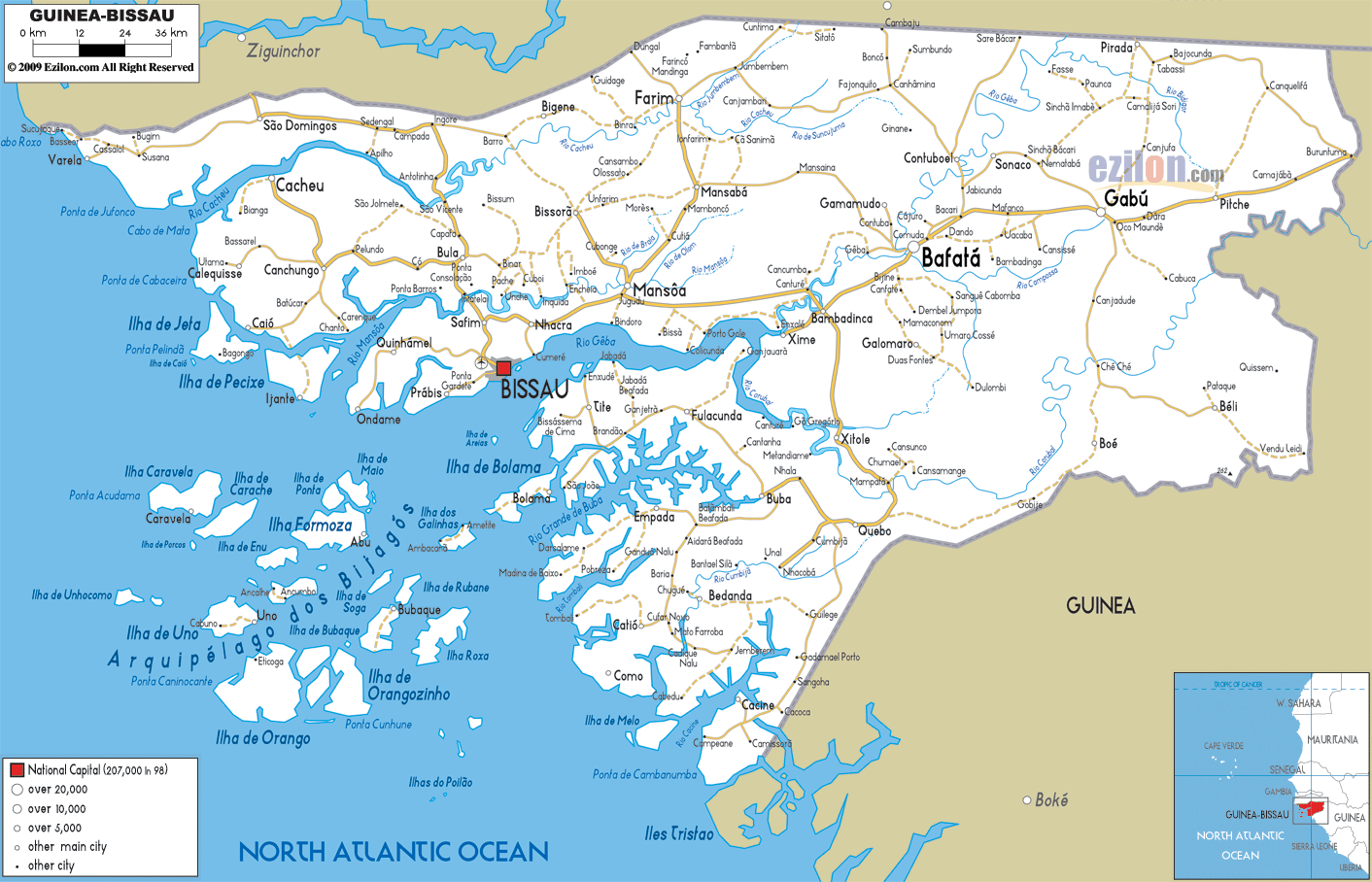
It was first Senegal, then it moved on to Mali and now it’s Guinea Bissau. Guinea Bissau is back in the news again with a thump and as it’s so associated with this small coastal West African nation with many islets in the Atlantic Ocean, it is for all the bad reasons.

West Africa is indeed an interesting sub-region of Africa. On Thursday, April 12, ECOWAS effectively forced Malian soldiers who annexed power in March 22 this year to hand over power to a civilian interim administration led by the former speaker of parliament, Dioncounda Traore.

Even as this was going on in the Malian capital Bamako, Guinea Bissau’s army were quietly fine tuning plans to topple the government and disrupt the April 29 presidential election run-off.

Guinea Bissau
The former Prime Minister, Carlos Gomes Júnior, who won the first round of the presidential election was almost certain of winning the run-off election. 

He is now under arrest, even feared dead, after the army attacked his house on Thursday night, three weeks after Mali’s former president was driven out of office by Capt Amadou Sanogo and his visionless, clueless and directionless thugs.

Disparagingly described by many as Africa’s first narco-state, the country is barely livable: high levels of unemployment, there are no factories, unexploited natural resources, dismembered police and ragtag army infested with narco-traders and associated violence.

Guinea Bissau is not Somalia for sure but it’s still a tough country by any standard. Both countries are ungovernable, even anarchic if you like. Robert Kaplan may not need to revise his 1994 thesis again anytime soon.

It’s scandalous to say that a country is used to coups but Guinea Bissau may be very close to this. Just as this morning, April 13, 2012, on December 26, 2011 the country’s population woke up to the sound of gun and artillery fire from an attempted coup d’tat while the President, Malam Bacai Sanha was receiving medical attention in France. 

The coup failed but the president also never recovered from his illness, diabetes.

Earlier in June 2009, just a couple of weeks to scheduled presidential elections (June 28 to be specific), the military assassinated Baciro Dabo, a leading presidential candidate and Helder Proenca, an ex-defence minister.

These killings took place on the same day but separately. Needless to say, both assassinations were linked. Dabo and Proenca were allegedly plotting a coup to kill Prime Minister Carlos Gomes Júnior and the country’s army chief of staff, Jose Zamora Induta. The same Gomes Júnior who was arrested during last night’s coup.

Gomes Júnior had resigned in February 2012, a month after former president, Sanha died in France, to contest the March presidential election. He won the first round by twice as many votes as his closest rival and former president, Kumba Yala. But with last night’s army putsch, the presidential run-off between will almost certainly not take place on April 29.

Violent clashes are not limited to the politicians and the soldiers in Guinea Bissau. Infighting within the army is intense and so is fighting within the dismembered police service and other Bissau’s security agencies. Factions regularly fight over which group controls the drugs trade and other resources of the country.

Gomes Junior casting his ballot
Irony: Guinea Bissau soldiers queue to vote
It’s a circle of mutinies, coups, uprisings, assassinations and now narcotics trade. Over the last few years, the viciousness seems to have been cranked up. 

It is easily attributable to the spoils of the drugs trade and the acute power struggle between the political class and the politically powerful military.

Guinea Bissau is now a major a staging post for the trans-shipment of narcotics from South America to coke-addicted Europe via West Africa. 

President Joao Bernardo ‘Nino’ Viera, who himself first came to power by toppling Luis Cabral, was murdered by the army on March 2, 2009. Viera’s assassination was partly fueled by an earlier bomb attack on and subsequent murder of his key political rival and army chief of staff, General Batiste Tagme na Waie long suspected to be involved in the drugs trade.

If you thought the plot of Guinea Bissau’s intriguingly opaque and checkered power struggle and political chess game is complicated, you're right. Dabo who was killed in June 2009, three months after the assassination of President Viera was a close associate of the president. 

The army apparently panicked Dabo could pursue them if he won the elections to jail those (soldiers and non soldiers) who plotted and assassinated Viera.

Economically, Guinea Bissau is an even more insignificant economy than Mali in West Africa but the danger it poses to the larger region is grave given its uncharitable reputable as a major narcotics transiting and arms trafficking enclave within the sub-region.

So what can we expect from the regional body, ECOWAS? ECOWAS will quickly get involved in Guinea Bissau as it has done before to restore order.

But the sub-regional grouping is likely to be more nuanced in how it tackles this country in comparison with Mali for a number of reasons not least because Bissau is a longstanding troubled country needing a more careful nudge to remold the failing state and move it and the long-suffering population away from a rather violent and unstable past to a stable and progressive path. 

Put simply, ECOWAS won't adopt a 'machoman' posture with Bissau.

Over to you, ECOWAS!

Tuesday, 3 April 2012

Captain Sanogo’s Catch-22

The military thugs in Mali seem to have beaten far more than they could chew. From the swift change in tone of Capt Amadou Sanogo and his men, it does look like they wouldn’t have embarked on the adventure if they figured early that the ECOWAS axe would fall so heavily and swiftly on their heads.

ECOWAS leaders
Mid-rank soldiers of the Malian army toppled the elected president, Amadou Toure in March. The former president has since gone into hiding. Some of his ministers are under arrest.

Although the soldiers have since made a U-turn with promises to reinstate the Constitution they tossed into the bin when they annexed power two weeks ago, their motivations for the coup is not simply because the war in the north with the Tuaregs was badly prosecuted by the commander-in-chief, the former president.

The soldiers sought to appropriate power as they read the then scheduled April 29 election would have legitimized whoever was elected and make their thirst for power even more difficult to quench. Been a landlocked country and the northern half in the grip of the Tuareg secessionists, the soldiers are trapped between ECOWAS’ regional embargo and the rebels. 

Mauritania and Algeria also neighbours but who are not members of ECOWAS have adopted the regional body’s sanctions against Mali.

ECOWAS seem to have internalised recent lessons bothering on collective action in the region. Last year the regional grouping cut off former president of Cote d’Ivoire, Laurent Gbagbo, by freezing the country’s accounts at the height of the post-election crisis. 

The move quickly whittled Gbagbo’s influence over the south of the country before he was crushed by French soldiers and forces loyal to Alassane Ouattara.

Capt. Sanogo
One way out for the coup makers in Mali is for the army to accede to the demands of the regional body and return power to the former civilian administration. 

The other is to attempt to overrun the Tuareg rebels and recapture the northern territories to consolidate power.

The latter doesn’t look the least feasible as the balance of power now weighs heavily against the Army. Equally important is the fact that the Malian army doesn’t have access to the means, the war chest – finance, fuel, food and other logistics to pursue the war to any logical end given the ECOWAS sanctions.

Economically, Mali is not a very important player in West Africa let alone Africa. The economy is comparatively tiny albeit the landmass is huge and steeped in ancient history with Timbuktu as the centrepiece. Politically, however, the country has for the most part been a very important regional actor right from the days of independence struggle in the 1950s.
 
The next few days are critical to how the Malian conundrum is resolved and a redefinition of security in the West African sub-region. Mali’s example is set to also define how other regions of Africa respond to future military takeovers in their neighbourhoods.

Thursday, 22 March 2012

Ghana's democracy while we slept


Ok, if you don’t like how a news media covers your government and political party, issue a fiat forbidding all your appointees, other public officials, departments and agencies from speaking to that media house. 

You probably can do that (and get away with it) if you run your own small company or fiefdom but certainly not when you’re governing a post-modern democratic state.

But that’s exactly what the Government of Ghana has done. On Tuesday, March 20, the government issued an order prohibiting all appointees from granting interviews to or advertising on the platforms of the country’s leading independent multimedia company, Multimedia Group Limited.

The government’s move came as a surprise to many. Not only is the administration’s action clearly undemocratic, utterly illegal and unnecessary exercise of power, it is also heavily tinged with arrogance.

Ghana’s 4th republican constitution, in letter and spirit, frowns on this sort of arbitrary use of state power. The constitution guarantees the right of the media, free speech and expressly recognizes the media as the fourth estate of the realm.

President Mills (R) and his veep, John Mahama
According to government, the action is borne out of the fact that it doesn’t like the way the media organization’s networks report on the government and the ruling party.

Multimedia Group Limited owns and operates Joy FM, by far Ghana’s best and indeed one of Africa’s leading radio stations. The company runs the Multi TV network. Altogether, Multimedia Group Limited operates 20 radio and TV channels. 

It also has dozens of affiliates which rebroadcast its flagship programmes right across Ghana and on the internet every day. The comprehensive Myjoyline website is a leader in online news in Ghana.

I’ve a confession to make here: I worked briefly with Multimedia after graduate school but that’s beside the point.

Historically, the NDC has had a rather fractious relationship with the media. In July 2001, the John Kufour NPP administration repealed the criminal libel and seditious laws of the country.   

In the 1990s, NDC government appointees and affiliates had used these laws during Jerry Rawlings administration to bully and jail journalists.

After promising while in opposition to pass the Right to Information Bill into law in 2008, the Mills administration has so far reneged on that promise – with just about eight months to face the electorate again. Ghanaians head to the polls in December to elect a president and legislatures. President Mills won the 2008 election by a wafer-thin margin.

Government’s claim its heavy-handed move is in direct response to Multimedia Group’s supposed unfairness in the coverage of the ruling party is simply untenable and it is also not doing itself any favours in a competitive election year as this.

This action only plays into the hands of the opposition which will no doubt capitalize on it to characterize the Mills administration as intolerant and undemocratic. Ghanaians take their democracy and freedom of speech seriously -- just listen to or watch any of the morning show programmes on radio or TV). 

Therefore, arbitrarily proscribing a major news and entertainment network such as the Multimedia Group from covering state events can only hit the government where it hurts most, public perception and possibly at the polls later in the year. Already political campaigns have intensified.

Ghana’s laws guarantee the right to rejoinder and civil suit against false allegations and unfair media reporting. For the administration to therefore take such a drastic action speaks to how precarious the country’s democracy is.

Ghana is an ‘anchor state’, a shining example of modern democratic governance in Africa but this is clearly under threat. Recording a remarkable growth rate of 13.5 per cent in 2011 and an increasingly vibrant economy buoyed by recent oil discovery and exports, the country enjoys tremendous goodwill in Africa and globally.

The government must step back from this atypical and impulsive exercise of power, retract the order and apologize to Ghanaians for denting their confidence in the country’s democracy.

Friday, 16 March 2012

Jamestown, gays and elections


Jamestown (Accra) and gay rights, what’s the connection? Not really. Well not until this week. Jamestown is one of the original communities of Ghana’s ever expanding capital, Accra.

The suburb is named after a fort built by the British in 1673 and named after King James II, who was a major shareholder in the Royal African Company that traded in gold, slaves and whisky before he ascended the throne. The fort is now a prison –James Fort Remand Prison.

Also known as British Accra (there are Danish Accra and Dutch Accra), Jamestown warmly kisses the Atlantic Ocean in the south and the rather polluted Korle Lagoon on the west. With a large population and a heavily overstretched public infrastructure, Jamestown is a bustling community and the childhood home of some of Ghana’s best boxers and footballers.

A protest against same-sex relationships early in the week has forced homosexuality and gay rights back into the middle of hot-button topics in this political season. Ghanaians go to the polls to elect a president and parliamentarians in December.

The Jamestown protesters including females assaulted revellers attending an early morning marriage ceremony of a lesbian couple with sticks and canes. The protesters arrested two females, a 19-year-old and a 16-year-old who were at the function and sent them to the local police station and urged the police to arrest all gays in the community. But the reasons for the protest and subsequent attacks were not the usual religious, health or the standard socio-cultural reasons.

For the Jamestown anti-gay activists, the level of lesbianism in the area in particular is depriving men of girlfriends and future wives. That is to say there is an emerging shortage of women or they do not want to compete with other lesbians for women to date.

‘Their activities are depriving us of women. Anytime a man decides to go after a woman in the area these lesbians will pounce on him and beat him up. We cannot allow this to go on in the area. These women use money to lure the young girls into this bad habit and deprive us. It must stop,’ the local press quoted one anti-gay activist.

Now that’s a rather fairly new reason for the growing opposition to homosexuality. In the past, the reasons for public opposition were mainly because the practice is a ‘disgusting western’ concept inimical to African values and also because all three dominant faiths – Christianity, Islam and traditional African religion – frown on same-sex relationships.

In November 2011, Ghana’s president, John Atta Mills called the bluff of British PM, David Cameron to cut aid to African nations with anti-gay legislation. Reacting to Cameron’s threats, Mills told Ghanaians the country will never capitulate to Britain or any other country’s whim to legalise same-sex relationships. 

‘I, as president of this nation, will never initiate or support any attempt to legalise homosexuality in Ghana’. 

‘No one can deny Prime Minister Cameron his right to make policies, take initiatives or make statements that reflect his societal norms and ideals but he does not have the right to direct other sovereign nations as to what they should do especially where their societal norms and ideals are different from those which exist in [the] Prime Minister’s society...
‘Let me also say that whiles we acknowledge all the financial assistance and all the aid which has been given to us by our development partners, we will not accept any aid with strings attached, if that aid will not inure to our interest or the implementation or the utilisation of that aid with strings attached would rather worsen our plight as a nation or destroy the very society that we want to use the money to improve,’ the soft-spoken president and former law lecturer said tersely.
Uganda’sYuweri Museveni and Zimbabwe’s Robert Mugabe attacked Cameron as ‘satanic’ over his gay rights threat. Nigeria also asked Cameron to go to hell. But a week ago, a British cardinal and leader of the Catholic Church in Scotland also described the Cameron government’s plans to legalise gay marriage in Britain as ‘madness’, ‘a grotesque subversion of a universally accepted human right’ and a ‘redefinition of reality’.

Jamestown anti-gay protesters
Public resentment of same-sex relationship is deep and widespread in Ghana and much of Africa. Homophobia is mostly expressed as attempts to preserve the sanity and socio-cultural fabric of the African society.

With the exception of South Africa no other African country has legalised same-sex relationships. Gay relationships are thus a crime in many of these countries. Classified as ‘unnatural carnal knowledge’, they are considered a misdemeanor in Ghana’s penal code and in most other African nations.

Nigeria and Uganda recently sought to pass new laws in their Parliaments expressly banning homosexuality as well as impose stiffer custodial sentences.

Going to Ghana’s December 2012 elections, the make or break issue is the national economy. The economy grew by 13.5 per cent in 2011 one of the highest growth rates in world albeit it was fueled by oil exports.  
Apart from Mills other presidential aspirants have yet to publicly pronounce on same-sex relationships. But Jamestown may just have pulled the trigger on an issue that may play no mean a role in who gets crowned as Ghana’s president in January 2013 when whoever is elected will assume office.

Thursday, 23 February 2012

Democracy in Africa’s post-conflict states

From Angola to Sierra Leone, Rwanda to Guinea Bissau and Congo DR to Mozambique, two defining elements unite all peace agreements brokered after the Cold War to end civil wars in Africa. The trend runs round the world, from Bosnia to El Salvador and Afghanistan to East Timor. Liberal democracy and free market systems are two elements fastened to the heart of states recovering from violent conflicts, ostensibly to assist these countries make the transition to peace from a state of anarchy and bloodbath. 

Indeed, fundamental values of the global agenda in the last two decades have hinged on multi-party democracy and laissez faire capitalism. Weaving democracy and free market economy into peace agreements are based on a number of assumptions. Democracy, unlike other forms of governance, has inherent checks and balances to mitigate the inclination to resort to violence to resolve political differences. 


Central to the assumption underlining free market economy is that markets (and not states) are better guarantors of development (defined as material prosperity) for all because, adherents argue, the benefits will trickle down even to the weakest and most disadvantaged in society. But it is also the case that multi-party democracy and free market are the dominant political and economic models of development in the new world order, in which there’s substantively still only one global policeman.

Legitimacy
Historically, there have been many forms of legitimacy but surely in the 21st century, the only serious form of legitimacy is democracy. Thus, multi-party elections are today about the only internationally acceptable route to power. However, elections have turned out to be one of the ways to appease top echelons of feuding factions to a conflict in states rebuilding after long periods of civil war. In effect, elections may produce outcomes that may be described as ‘democratic’ but may not necessarily lead to peace or development.

Many studies around the world have established links between development and democracy. However, the causal relationship, if any, between Africa’s marginally improved economic performance and the democratisation wave that swept across Sub-Saharan Africa in the 1990s and the early years of the 21st century remain a hugely contested issue. 

Nevertheless, the value and significance of open, free and fair elections in countries transitioning from conflict to peace or consolidation of peace can hardly be underestimated. Successful political and governance transition is central to any post-conflict nation-building project. Rebuilding public institutions such as roads, hospitals, schools, law courts, prisons and regulatory agencies is fundamental to sustainability of the state.

Appeasement
True, the constitution-making process after a violent conflict offers a distinct opportunity to create a sense of common vision of the future of the state and even a ‘road map’ on how to get there. Accordingly, the constitution of these troubled African countries, of which a good number are slowly recovering, were partly peace agreements and partly a framework setting out the rules by which the new form of governance, democracy, will hinge.

Elections lend sought-after credibility to the leadership and institutions that emerge to replace structures imposed on the country and its population during the conflict and in the case of Africa, many of these wars span across decades and run deep. Angola’s war, fought over 27 years, ended in 2002, Mozambique’s 17-year-old war come to an end in 1992 with the Rome General Peace Accords and Liberia and Sierra Leone’s hot wars ended in 2001 and 2002 respectively. All were followed by multi-party elections.

Elections serve more than one purpose especially in the post-conflict context. Aside providing legitimacy and international credibility to post-conflict administrations, they also encourage democratic values such as tolerance and inclusiveness. Elections also help mark formal end of conflicts and promote state-building after bitter conflicts. But in Liberia, as in Congo DR and Sierra Leone, an earlier general election in 1997 failed to end the conflict. 

The chief architect of the Liberian war, Charles Taylor, emerged president of the war-battered country after the 1997 elections. However, the ex-rebel leader’s presidency was short-lived as a new rebel faction, the Liberian United for Reconciliation and Democracy (LURD), militarily challenged President Taylor’s democratic dictatorship. Amos Sawyerr, the former President of Liberia’s Interim Government puts the 1997 election shenanigans and Taylor’s reign most succinctly when he said: ‘The state we produced turned out to be a criminal state, legitimized by elections’.

Economy
In 2007, Sierra Leone held its second post-conflict elections in which the opposition party candidate, Ernest Bai Koroma won in a tight run-off. The immediate past president, Ahmed Tijan Kabbah of the Sierra Leone Peoples Party (SLPP) handed over the reins of power to the All Peoples Congress (APC) led by President Bai Koroma. Bai Koroma beat Kabbah’s vice president and flagbearer of the SLPP, Solomon Berewa. The smooth transition marked the first time ever of a peaceful and democratic handover of power from one political party to another in the country’s history.

Bai Koroma’s job is cut out. The reconstruction of the country has focused on organization of elections and re-training of the security agencies. Yet, the economic disempowerment and political exclusion of the youth, graft and unfettered influence of traditional authorities constitute three of the key factors that triggered the violent outburst that engulfed the country. Three-fourths of Sierra Leone’s 5.2 million people, most them being the youth, are jobless.

One of the greatest failures of democratisation and state-building in Sierra Leone, but also in Liberia, Guinea Bissau, Angola, Mozambique and Congo DR, has been on the economic front. Mismanagement of public resources is widespread, while majority of the people live in squalor. With the exception of Guinea Bissau and Mozambique, the rest of these post-war countries are well-endowed with natural resources including oil, diamond, iron ore, platinum and cobalt. Prices of these commodities were at phenomenal levels until they started slipping from the middle of 2008.

The UNDP Human Development Index (2007/2008) ranks Sierra Leone 176 out of 177 countries. At 40.5 years, life expectancy in Sierra Leone is even below the African average, seven years after the war ended there.

Angola, Africa’s fastest growing economy ranks 162, yet the country’s economy has been expanding at a phenomenal pace – an annual average of about 19 per cent since 2000. As Africa’s leading oil exporter, Angola raked in billions of dollars during the spike in oil prices but the dos Santos MPLA-government is corrupt, incompetent and wasteful.

Transparency International, the anti-corruption watchdog, rates Angola as one of the most corrupt countries in the world. There is next to no investment in the larger rural population and basic infrastructure beyond Luanda, the national capital any wonder Angolans feel terribly disillusioned.

Other development indicators for Sierra Leone are equally stark. Sierra Leone’s agricultural sector provides about three-fourths of jobs however, the Disarmament, Demobilisation and Reintegration (DDR) programme trained ex-combatants as plumbers, carpenters and mechanics. In spite of its centrality to Sierra Leone’s recovery, only a handful opted for life in agriculture as the incentives for resettlement were comparatively far worse than for those settled as plumbers, carpenters or mechanics. At its peak, the reconstruction was costing the United Nations some US$16.4 billion and the British government US$150 million a year.

The democracy dividend promised at the end of the war in 2002 remains a mirage for the bulk of the population. Bretton Woods institutions and other donors’ insistence on liberalisation, privatisation and deregulation of public goods with next to no social safety net for even the most vulnerable, has also complicated the rebuilding of the country’s infrastructure which were all damaged or destroyed during the conflict.

It was thought that spearheading reconstruction agenda with democratisation alongside liberalised markets would address the fundamental causes of the war, which includes institutional weakness, endemic corruption, youth alienation and abysmal human rights records as well as promote productivity and innovation.

This has yet to happen in many of these post-conflict states. Cote d’Ivoire, the Central African Republic and Congo-Brazaville and Niger remain extremely volatile. Guinea Bissau, Sierra Leone and Liberia are sitting on knife-edge as a surging trade in narcotics from Latin America takes hold along the West African coast. Congo DR has fractured with dissident rebels fighting the Kinshasa government of President Joseph Kabila. In spite of the Comprehensive Peace Agreement (CPA) and elections in the south of the country, Sudan is at war as the genocide continues in the Darfur region of the country. The International Criminal Court (ICC) is set to indict the Sudanese president on war crime charges.

It is not completely bleak. Although the rebel Rwanda Patriotic Front (RPF) leader, Paul Kagame, remains in charge as president of the country after he was returned through an election, the country has remarkably remade itself after the 1994 genocide.

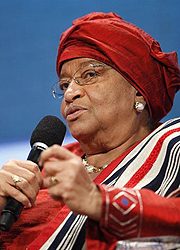
President Johnson-Sirleaf
Indeed, in some specific aspect of liberal democracy, economic freedom and popular participation in politics, the tiny East African country is a world leader. Women in Rwanda now lead the world rankings of women in national parliaments, with 49 per cent of representation compared to a world average of just about 15 per cent.

As part of the country’s new constitution drafted after 1994, 24 of the 80 seats in the lower house of parliament are reserved for women. Also reserved for women are six out of the 20 in the upper house.
The breakthrough in Rwanda is partly the result of intense lobby by women, the civil war and women’s involvement in drafting the new constitution and voting guidelines that guaranteed seats for women candidates. In sync with international targets, Mozambique and South Africa, two countries transitioning from a long history of civil strife, women hold at least 30 per cent of the seats in parliament.

In 2005, Africa got its first female president. Ellen Johnson-Sirleaf rose to power in a keenly contested election in Liberia after former president Charles Taylor was forced out of office. Taylor is now facing trial at the ICC in The Hague for his government’s material support to the murderous Revolutionary United Front (RUF) rebels who reduced Sierra Leone to a failed state in the brutal decade-long war.

The symbolism of these strides by (women in) African countries recovering from war is significant but it’s far from generating sufficient momentum to shape the mix of economic and social policies to address the structural imbalance and reform institutional practices that consign majority of women to the periphery and penury.

The more plausible question, perhaps, is what impacts are (or would) these developments have on the quality of life of ordinary citizens, especially women and evolution of democratic norms in these countries.

It is noteworthy that African countries which have recorded a significant improvement in women’s participation in governance have done so through adoption of quota systems. This has not necessarily translated into better living conditions for women and their dependants. More specifically, it is not guaranteed that these women would necessarily pursue policies that benefit the majority of women. Suffice to state, however, that it may level the playing field on which women battle for equality.

But quite a number of studies in Africa and elsewhere show that where women are actively involved in the crafting and implementation of development strategies, they are more likely to succeed and the benefits are also more direct – families are better fed, healthier, and their income, savings and investments go up, than if they were forced to the periphery.

Economic policies foisted on these same fragile nations by the international community undermine marginal progress made on the political front in these countries. The implementation of unmitigated neo-liberal threesome policy dictum of liberalisation, deregulation and privatisation have further perpetuated the injustices of the past including pricing basic services such as healthcare, education and sanitation above the reach of the most disadvantaged.

Democratisation has led to an explosion of media. But it is still dangerous for journalists to work in host of these countries. In February 2009, four Sierra Leonean female journalists were subjected to an extraordinary attack – abducted, stripped naked and forced to march through the streets of the eastern city of Kenema – for reporting on an anti-Female Genital Mutilation (FGM) campaign on the international day of zero tolerance for female circumcision. Kenema saw some of the worst atrocities during the Sierra Leone civil war. According to the United Nations, up to 94 per cent of women aged 15–49 in Sierra Leone suffer FGM.

Such impunity undermines the tenets of democracy of which freedom of speech and other basic human rights are intrinsic. Blatant violation of the rights of others is not uncommon. This is complicated by widespread corruption, joblessness and insecurity. These can only serve as fodder for instability in fragile democracies as Sierra Leone and many other transitioning countries on the continent.

Rwanda’s steady progress at democratic governance since the 1994 massacre, the Kagame administration is turning out to be one of the most repressive democratic regimes in East Africa. Critical media are ruthlessly closed down, journalists arbitrarily arrested and thrown in jail or forced to flee the country. New media law in the offing limits freedom of speech and criminalises the media for criticising the President or the army.
The legislation is ‘not a law but a death sentence for journalism in this country’, president of the Association of Rwandan Journalists, Gaspard Safari, has described it. Safari is the editor of the Umuvugizi, a leading private Kinyarwanda-language newspaper.

Rwanda, Sierra Leone and Liberia have instituted reconciliation commissions as a way to heal wounds opened by their wars. Charles Taylor is facing trial at the International Court of Justice in Hague for his involvement in the conflict in Sierra Leone. Some other high profile war criminals died (Sam Hinga Norman, General Mosquito and Foday Sankoh) before courts set up to try them passed judgment.
 
The challenge facing these post-conflict transition countries is indeed how to balance the competing demands to translate the peace into concrete development that benefits ordinary people on the streets.
Africa states generally lack the necessary capacity or the will to effectively perform core functions of statehood. For post-war recovery African states the crisis is dire and urgent: many are unwilling or simply unable to provide basic public services such as governing legitimately, ensuring physical security, fostering sustainable and equitable economic growth as well as other essential public goods such as clean water, affordable health care, schools, roads and decent jobs. The high level of youth unemployment is a major challenge to the security and development of these fragile countries.

For Sierra Leone, the reinstatement of the chieftaincy institution complicates the situation as it feeds into growing resentment and discontent against government and para-state institutions. Paramount chiefs are accused of injustices, non-transparency and unaccountability especially in the countryside. They were heavily implicated in the war itself.

But in the face of the unending global economic crisis, the task of rebuilding and consolidating the minimal political and socio-economic progress appear most daunting indeed. These post-conflict countries depend on Western countries for more than half of their capital expenditure budgets. Worse still, prices of commodities exported by these weak states have plummeted sharply in the last half-year impacting heavily on their revenue reserves. It is now feared that some all of these countries could actually slip into the abyss.

In the last few years there have been democratic reversals in African countries including Guinea and Mauritania. High food prices triggered violent street protests across the continent, from Liberia to Cameroon. Dozens died in these riots and attempts to quell the protests narrowed rather than expanded the frontiers of freedom and democracy. The creeping narcotic shipment in transit to Europe through some of these post-conflict states poses perhaps the severest danger to the expansion of the frontiers of democracy and development in Africa.

In spite of the challenges above, it is still fair to conclude that democracy is steadily taking root in many of these traumatized countries. It is inevitable, however, that in the pursuit of the ideal governance system, these countries do not overlook the socio-economic component of the post-war recovery agenda.