Showing posts with label ECOWAS. Show all posts

Tuesday, 26 November 2013

Kofi Bentil got it wrong on the EPAs

Kofi Bentil makes a very intriguing point about the so-called Economic Partnership Agreement (EPA) between Ghana and the European Union.

Bentil’s argument for signing the EPA is that we have no better option.

But this is simply not true.

We can meet the needs of the very few – five or so – exporters who will suffer distress by not signing the EPAs from the huge savings Ghana will make by not signing.

It will cost the exporters of banana, processed cocoa products and tuna a total of US$52 million annually in extra duties if we don’t sign. However, if we don’t sign, it will save the Ghanaian treasury a minimum of US$150 million (according to MOTI figures) or US$374 million (according to the#UNECA/South Centre) each year, which we could otherwise have lost in tariff revenue by signing.

Some of the savings can be used to support the distressed exporters for a period to allow them to diversify their export market.

That way, we will also save our domestic industries from the threat of inevitable collapse that signing the agreement will impose. We will also save the space for applying our own policies which will otherwise be sacrificed by signing the EPAs.

It is true that the EU has become even more single-minded in pursuit of its agenda for the deregulation of services, investment and government procurement, together with restrictive disciplines in IP and so forth – with the aim of obtaining free, unrestricted access for European investors to all sectors of Africa’s economies.

As to the thing about the EPAs being the result of failure of leadership and strategic thinking, that may be so, but we cannot punish the ordinary, hardworking people, producers, etc for the selfishness and irresponsibility of their leaders.

And nobody, as far as I am aware, has blamed colonialism for anything relating to the EPAs. The argument rather is that if we sign the EPAs in its current form, we will be returning our economy to what it was in colonial times/Guggisburg colonial economy – simple exporters of raw/bulk primary products in exchange for manufactured goods. i.e. Mere hewers of wood and drawers of water for the benefit of others in the international economic order.

Bentil doesn't seem to realize that the EPAs will take apart every attempt at regional integration in the sub-region. The ECOWAS region is a critical market for Ghanaian (and for that matter Nigerian, Ivorian and other West African) exporters of manufactured products and services. In effect, a full-blown EPA will sink Ghana’s attempts and future efforts at industrialization which really is a critical piece in moving this country into a meaningful middle income global player.

Even studies by the World Bank, apostles of liberalisation as we know them, have warned ECOWAS of the dire consequences of opening up their market by more than 60% in a free trade agreement. Under the EPAs Ghana will open its market by 75 %.

What Bentil doesn't also appear to get is that the EPA is a lock-in agreement, secured by a lock-in mechanism. At its barest, this means that if Ghana, for whatever reason, decides to offer better terms (than the EPA) to another country or bloc of countries, it will have to extend same to the EU. 

By the way, whatever meaningful leverage Ghana ever had to deal with such restrictive free trade agreements as the EPAs were whittled away under the structural adjustment programmes of the 1980s and 1990s and under HIPC/PRSP clan.

Friday, 13 April 2012

West Africa’s looming anarchy


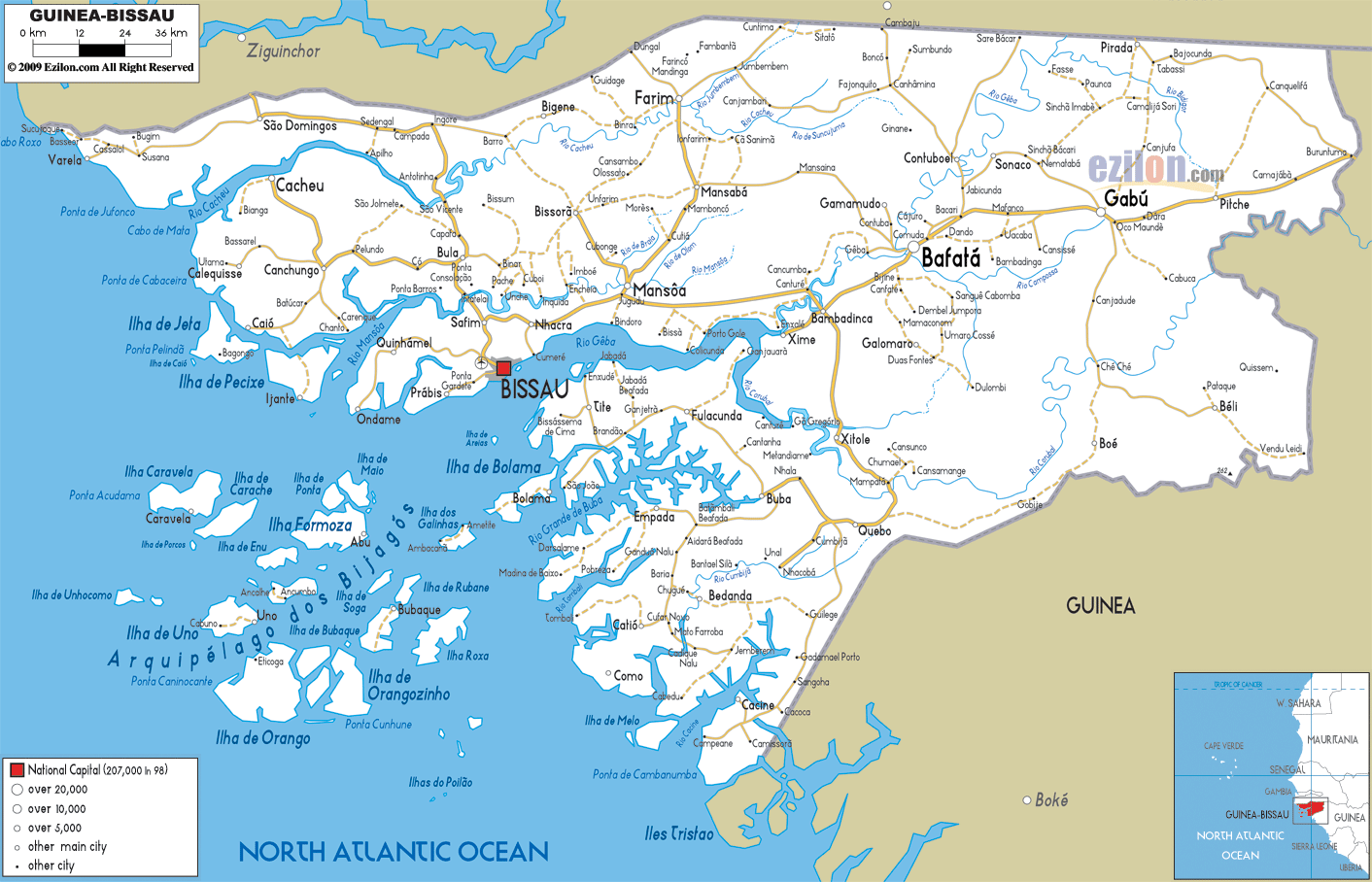
It was first Senegal, then it moved on to Mali and now it’s Guinea Bissau. Guinea Bissau is back in the news again with a thump and as it’s so associated with this small coastal West African nation with many islets in the Atlantic Ocean, it is for all the bad reasons.

West Africa is indeed an interesting sub-region of Africa. On Thursday, April 12, ECOWAS effectively forced Malian soldiers who annexed power in March 22 this year to hand over power to a civilian interim administration led by the former speaker of parliament, Dioncounda Traore.

Even as this was going on in the Malian capital Bamako, Guinea Bissau’s army were quietly fine tuning plans to topple the government and disrupt the April 29 presidential election run-off.

Guinea Bissau
The former Prime Minister, Carlos Gomes Júnior, who won the first round of the presidential election was almost certain of winning the run-off election. 

He is now under arrest, even feared dead, after the army attacked his house on Thursday night, three weeks after Mali’s former president was driven out of office by Capt Amadou Sanogo and his visionless, clueless and directionless thugs.

Disparagingly described by many as Africa’s first narco-state, the country is barely livable: high levels of unemployment, there are no factories, unexploited natural resources, dismembered police and ragtag army infested with narco-traders and associated violence.

Guinea Bissau is not Somalia for sure but it’s still a tough country by any standard. Both countries are ungovernable, even anarchic if you like. Robert Kaplan may not need to revise his 1994 thesis again anytime soon.

It’s scandalous to say that a country is used to coups but Guinea Bissau may be very close to this. Just as this morning, April 13, 2012, on December 26, 2011 the country’s population woke up to the sound of gun and artillery fire from an attempted coup d’tat while the President, Malam Bacai Sanha was receiving medical attention in France. 

The coup failed but the president also never recovered from his illness, diabetes.

Earlier in June 2009, just a couple of weeks to scheduled presidential elections (June 28 to be specific), the military assassinated Baciro Dabo, a leading presidential candidate and Helder Proenca, an ex-defence minister.

These killings took place on the same day but separately. Needless to say, both assassinations were linked. Dabo and Proenca were allegedly plotting a coup to kill Prime Minister Carlos Gomes Júnior and the country’s army chief of staff, Jose Zamora Induta. The same Gomes Júnior who was arrested during last night’s coup.

Gomes Júnior had resigned in February 2012, a month after former president, Sanha died in France, to contest the March presidential election. He won the first round by twice as many votes as his closest rival and former president, Kumba Yala. But with last night’s army putsch, the presidential run-off between will almost certainly not take place on April 29.

Violent clashes are not limited to the politicians and the soldiers in Guinea Bissau. Infighting within the army is intense and so is fighting within the dismembered police service and other Bissau’s security agencies. Factions regularly fight over which group controls the drugs trade and other resources of the country.

Gomes Junior casting his ballot
Irony: Guinea Bissau soldiers queue to vote
It’s a circle of mutinies, coups, uprisings, assassinations and now narcotics trade. Over the last few years, the viciousness seems to have been cranked up. 

It is easily attributable to the spoils of the drugs trade and the acute power struggle between the political class and the politically powerful military.

Guinea Bissau is now a major a staging post for the trans-shipment of narcotics from South America to coke-addicted Europe via West Africa. 

President Joao Bernardo ‘Nino’ Viera, who himself first came to power by toppling Luis Cabral, was murdered by the army on March 2, 2009. Viera’s assassination was partly fueled by an earlier bomb attack on and subsequent murder of his key political rival and army chief of staff, General Batiste Tagme na Waie long suspected to be involved in the drugs trade.

If you thought the plot of Guinea Bissau’s intriguingly opaque and checkered power struggle and political chess game is complicated, you're right. Dabo who was killed in June 2009, three months after the assassination of President Viera was a close associate of the president. 

The army apparently panicked Dabo could pursue them if he won the elections to jail those (soldiers and non soldiers) who plotted and assassinated Viera.

Economically, Guinea Bissau is an even more insignificant economy than Mali in West Africa but the danger it poses to the larger region is grave given its uncharitable reputable as a major narcotics transiting and arms trafficking enclave within the sub-region.

So what can we expect from the regional body, ECOWAS? ECOWAS will quickly get involved in Guinea Bissau as it has done before to restore order.

But the sub-regional grouping is likely to be more nuanced in how it tackles this country in comparison with Mali for a number of reasons not least because Bissau is a longstanding troubled country needing a more careful nudge to remold the failing state and move it and the long-suffering population away from a rather violent and unstable past to a stable and progressive path. 

Put simply, ECOWAS won't adopt a 'machoman' posture with Bissau.

Over to you, ECOWAS!

Tuesday, 3 April 2012

Captain Sanogo’s Catch-22

The military thugs in Mali seem to have beaten far more than they could chew. From the swift change in tone of Capt Amadou Sanogo and his men, it does look like they wouldn’t have embarked on the adventure if they figured early that the ECOWAS axe would fall so heavily and swiftly on their heads.

ECOWAS leaders
Mid-rank soldiers of the Malian army toppled the elected president, Amadou Toure in March. The former president has since gone into hiding. Some of his ministers are under arrest.

Although the soldiers have since made a U-turn with promises to reinstate the Constitution they tossed into the bin when they annexed power two weeks ago, their motivations for the coup is not simply because the war in the north with the Tuaregs was badly prosecuted by the commander-in-chief, the former president.

The soldiers sought to appropriate power as they read the then scheduled April 29 election would have legitimized whoever was elected and make their thirst for power even more difficult to quench. Been a landlocked country and the northern half in the grip of the Tuareg secessionists, the soldiers are trapped between ECOWAS’ regional embargo and the rebels. 

Mauritania and Algeria also neighbours but who are not members of ECOWAS have adopted the regional body’s sanctions against Mali.

ECOWAS seem to have internalised recent lessons bothering on collective action in the region. Last year the regional grouping cut off former president of Cote d’Ivoire, Laurent Gbagbo, by freezing the country’s accounts at the height of the post-election crisis. 

The move quickly whittled Gbagbo’s influence over the south of the country before he was crushed by French soldiers and forces loyal to Alassane Ouattara.

Capt. Sanogo
One way out for the coup makers in Mali is for the army to accede to the demands of the regional body and return power to the former civilian administration. 

The other is to attempt to overrun the Tuareg rebels and recapture the northern territories to consolidate power.

The latter doesn’t look the least feasible as the balance of power now weighs heavily against the Army. Equally important is the fact that the Malian army doesn’t have access to the means, the war chest – finance, fuel, food and other logistics to pursue the war to any logical end given the ECOWAS sanctions.

Economically, Mali is not a very important player in West Africa let alone Africa. The economy is comparatively tiny albeit the landmass is huge and steeped in ancient history with Timbuktu as the centrepiece. Politically, however, the country has for the most part been a very important regional actor right from the days of independence struggle in the 1950s.
 
The next few days are critical to how the Malian conundrum is resolved and a redefinition of security in the West African sub-region. Mali’s example is set to also define how other regions of Africa respond to future military takeovers in their neighbourhoods.